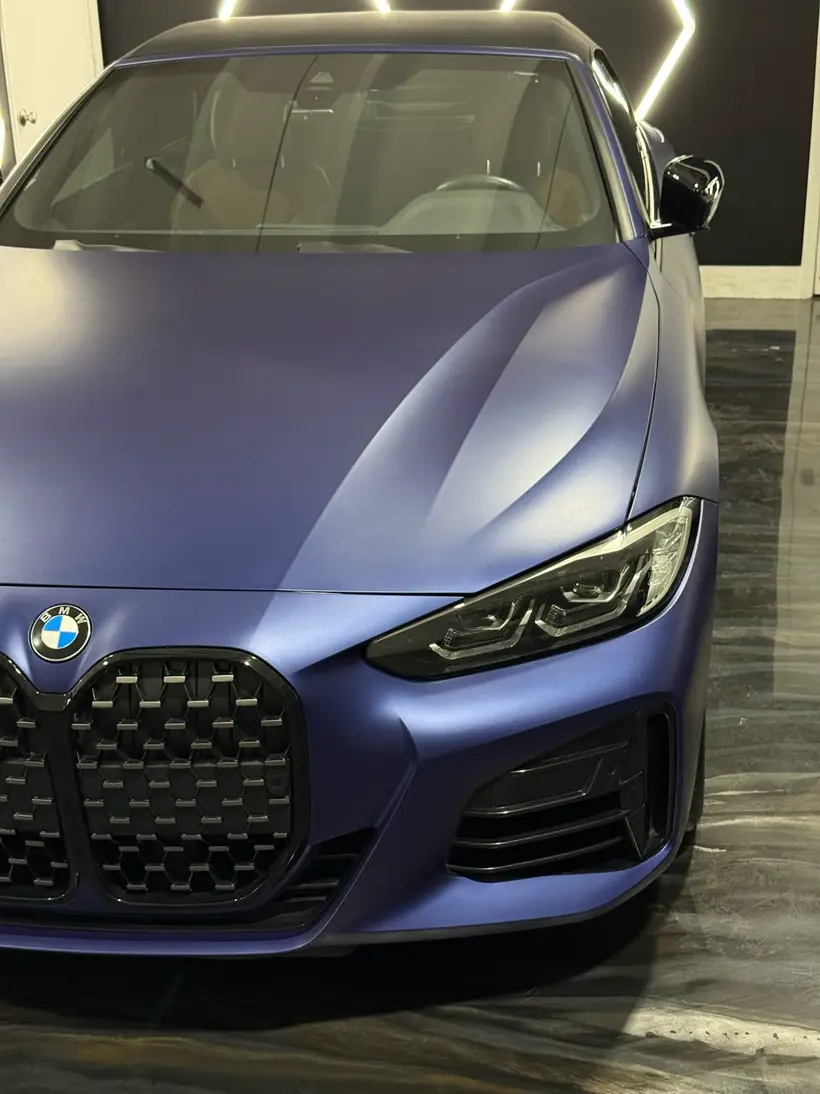
Hexis Wrap and Hexis Vinyl, Installed in Davie, FL
Hexis is one of the five wrap films we install, and it is the one most people have to look up. It is French: HEXIS has been making self-adhesive film in Frontignan since 1989, and that is still where the film is cast. In the wrap world it is known less for its everyday colors than for what sits at the far end of its range — chrome, satin chrome and textured finishes that most brands either do not make or do not make well.
The color-change line is called SKINTAC, and it comes in two series. HX20000 is the everyday bench: 85 gloss, 21 matte and 12 satin colors, 3.9 mil, rated by Hexis for up to 6 years. HX30000 is the specialty side: 29 chrome finishes and 11 textured ones, plus 35 gloss and 16 satin, running anywhere from 2.7 to 11 mil depending on how the finish is built, and rated for up to 5 years.
We install it out of one climate-controlled shop in Davie, panel by panel with the trim off, the same way we install 3M, Avery Dennison, Inozetek and Evolve. What follows is what Hexis publishes about its own film, what we have found it is genuinely good for, and one honest limitation up front: there is no Hexis color grid on this site. Picking a Hexis color means coming in and laying the real film against your own paint.
Hexis is a manufacturer, not a rebranded roll
There are a lot of wrap "brands" that are really a logo printed on somebody else's film. Hexis is not one of them. HEXIS has manufactured self-adhesive film since 1989, and its own store still puts it plainly: proudly manufactured in Frontignan, France. The Western Hemisphere side of the business, HEXIS Americas, runs distribution for the USA, Canada and Latin America out of Lawrenceville, Georgia.
Color change is only part of what they make. The automotive range Hexis publishes includes:
- SKINTAC — the cast color-change wrap films, HX20000 and HX30000
- HXONE — a super gloss finish, offered in 7 colors
- BODYFENCE — paint protection film
- SKYTINT — automotive solar window film
- HEXLIGHTS — headlight and taillight film
They also run their own training in the US: three-day wrapping and PPF courses taught by Certified HEXIS Trainers. One detail worth knowing if you are comparing shops — Hexis states that finishing the course does not by itself certify anyone. Certification is a separate one-day written and practical exam. Sitting in the class and passing the test are two different things, and plenty of the industry uses those words as if they were the same.
SKINTAC HX20000 and HX30000, side by side
Both series are high-performance cast PVC with a clear permanent solvent-based acrylic adhesive and the HEX-PRESS air-release liner, sold in 82-foot rolls. Here is where they part company, using Hexis' own published numbers:
- SKINTAC HX20000 — 3.9 mil, 60 inches wide, up to 6 years durability. 85 gloss, 21 matte, 12 satin and one wet-look color.
- SKINTAC HX30000 — 2.7 to 11 mil, 54 and 60 inches wide, up to 5 years durability. 35 gloss, 16 satin, 3 matte, 29 chrome and 11 textured finishes.
The thickness spread on the HX30000 is the tell, and it is the thing most comparison charts miss. A chrome or a honeycomb texture is not a pigmented sheet — it is a built-up construction, and it lands far thicker and stiffer than a 3.9 mil gloss. That is why one series can span 2.7 mil to 11 mil under a single name. It is also why the two films do not install the same way, do not conform the same way around a mirror cap or a deep bumper radius, and should not be quoted as if they were interchangeable.
Read simply: HX20000 is where the solid colors live. HX30000 is where the chrome and the texture live.
What "up to 5 years" is actually saying
Hexis publishes those durability figures with a footnote attached, and we would rather quote the footnote than bury it. Hexis states that the durability of the material can vary based on geographical location, orientation — vertical versus horizontal — and aftercare practices.
In South Florida all three of those work against you at once. The horizontal panels are the ones that age: roof, hood, trunk lid. They take the sun straight down for most of the day, every day, and they are the panels that go dull, chalk or lift first on any brand of film, not just this one. Vertical panels — doors, quarters, fenders — routinely outlive them by a wide margin on the same car.
So we will tell you what Hexis rates the film for. We will not turn that into a promise of a specific warranty term on your car, because Hexis has not published a warranty document we can hold up, and we do not repeat manufacturer warranty claims we cannot source. What we do stand behind is on our warranty page, in writing, before the car goes in the bay.
Where Hexis actually earns its place on our rack
We keep five wrap lines because no single one is best at everything, and pretending otherwise is how people end up with the wrong film on a car they love.
- Inozetek — super gloss depth. When the brief is "I want it to look like it came out of a paint booth," this is usually the answer.
- 3M 2080 and Avery Dennison SW900 — the widest everyday catalogs, and the films our crew has the most hours in. Most full color changes start here.
- Evolve — the line we are certified with.
- Hexis — chrome, satin chrome and texture. 29 chrome finishes and 11 textured finishes in one series is not a normal thing for a wrap manufacturer to carry.
Which means the honest version is this: if you walk in asking for a straight gloss black, we are not going to steer you into Hexis so we can say we used it. If you want a satin chrome, a color-shift, a brushed or honeycomb texture on a roof or a set of accents, Hexis is very often the first roll we reach for.
The Hexis color catalog, and why it is not on this page
We publish full swatch grids for the other four lines — 126 colors in 3M 2080, 150 in Avery Dennison SW900, 105 in Inozetek and 59 in Evolve — because we hold those catalogs in a usable digital form. We do not have a Hexis grid on the site yet, so we are not going to fake one. You will not find invented Hexis color codes here.
What that means practically: a Hexis color gets chosen in the shop, from physical samples, laid against your own paint in daylight. Which, for what it is worth, is what we recommend for every brand anyway. A chrome or a color-flip photographed for a screen tells you almost nothing — satin black reads as matte black on a phone, and a metallic flake barely registers at all. Chrome is the worst offender of the lot.
The consult is free, there is no deposit to book it, and you leave with a written price for your exact vehicle whether you buy anything or not.
Installing chrome and textured film is not the same job
A thicker, stiffer film is less forgiving of everything. It does not stretch and recover the way a thin gloss does, it holds a squeegee mark, and it shows an over-stretch as a visible dull patch that will not heat back out. On a mirrored finish there is nowhere for a mistake to hide.
So it gets the same process we use on every wrap, and the process is the point:
- The car is planned before a single sheet is cut — which panels come apart, where every seam lands, how each edge gets wrapped under instead of trimmed at the surface.
- Handles, badges and trim come off where the design calls for it, so the film goes under the edge rather than stopping at it.
- It goes on indoors, one panel at a time. Dust and humidity are what put bubbles and lifted edges under film. Our bay is climate-controlled and never sees either.
- Squeegeed and post-heated so the film stays where we put it instead of creeping back over the first hot month.
We take 30 to 40 vehicles a month on purpose. Fewer cars on the floor is how yours gets the hours a chrome or textured install actually needs.
What it costs, and how to start
Full color change wraps at Elite start at $3,000. The final number depends on your vehicle, how much disassembly it needs, the condition of the paint underneath and which film and finish you choose. Chrome delete, roof wraps and accent work are priced on their own and cost far less than a full car. Anything outside that starting price is quoted per vehicle after a free inspection —
- Free inspection first. No deposit, no obligation, written price before anything starts.
- 0% financing for 12 months through Synchrony, on every service we offer, with a decision in minutes at the shop.
- Loaner Car Assistance. Enterprise is a mile away. We book it at our partner rate, around $35 a day, and drive you over. When you return it, they bring you back to us. No extra charge either way.
- One shop for the whole build. Wrap, paint protection film, ceramic coating and tint on the same visit, by the same crew.
We are at 5150 SW 48th Way, Unit 614, Davie, FL 33314 — next to the Hard Rock Hotel, five minutes off I-595. Monday through Saturday, 9 AM to 5 PM. 10+ combined years serving South Florida, 4,600-plus vehicles, and hundreds of 5-star reviews.
About Hexis Wrap and Hexis Vinyl, Installed in Davie, FL
What is the difference between Hexis SKINTAC HX20000 and HX30000?
HX20000 is the solid-color series: 3.9 mil, 60 inches wide, and 85 gloss, 21 matte, 12 satin and one wet-look color, rated by Hexis for up to 6 years. HX30000 is the specialty series: 29 chrome and 11 textured finishes plus 35 gloss, 16 satin and 3 matte, running 2.7 to 11 mil depending on the finish, rated for up to 5 years. Both are cast PVC on the same solvent-based acrylic adhesive and HEX-PRESS air-release liner. In practice, HX20000 is where you go for a color and HX30000 is where you go for chrome or texture.
Where is Hexis wrap film made?
In France. HEXIS has manufactured self-adhesive film since 1989 and casts it in Frontignan, in the south of France. The company's own store states it is proudly manufactured there. HEXIS Americas handles distribution for the USA, Canada and Latin America from Lawrenceville, Georgia.
Does Hexis make a chrome wrap?
Yes, and it is the main reason Hexis is on our rack. The SKINTAC HX30000 series carries 29 chrome finishes plus 11 textured ones, which is an unusually deep specialty bench for a single wrap series. Chrome film is thicker and stiffer than standard gloss — the HX30000 series runs up to 11 mil — so it is far less forgiving to install and should be quoted differently from a normal color change.
Can I see the Hexis colors online before I come in?
Not on our site, and we would rather say so than publish codes we cannot verify. We have digital swatch catalogs for 3M 2080, Avery Dennison SW900, Inozetek and Evolve, but not for Hexis yet. Hexis colors get chosen from physical samples at the shop, laid against your own paint in daylight. That is genuinely the better way to pick a chrome or a color-shift anyway — those finishes photograph nothing like they look on a car.
Is Hexis more expensive than 3M or Avery Dennison?
Film brand matters less to your final price than the finish you pick and how much the car has to come apart. A chrome or textured finish is a more involved install than a standard gloss regardless of who made the roll. Full color change wraps start at $3,000, and everything beyond that is quoted for your exact vehicle after a free inspection — with the real film in hand, not from a chart.
See the real film against your own paint. Book a free wrap consult in Davie — no deposit, no obligation, and you leave with a written price for your exact vehicle. Call (786) 876-7891 or (954) 335-3693, Monday to Saturday, 9 AM to 5 PM.
Protect it now. Pay over 12 months.
0% financing for 12 months with Synchrony. Approval in minutes, on every service.
200+ five-star Google reviews. Zero shortcuts.
Whether you want…
← swipe / use the arrows →
Showing 176 of our verified 5-star Google reviews · see them all on Google →
Common questions, answered.
Thinking about a wrap? Here is what it costs, how long it lasts, how it compares with paint and PPF, in plain English. Short video on most of them. Prefer to talk it through? Call us and in five minutes you will know what your car needs.
Vinyl Wrap 16 questions
Paint Protection Film 42 questions
 ▶ Video
 ▶ Video
 ▶ Video
 ▶ Video
 ▶ Video
 ▶ Video
 ▶ Video
 ▶ Video
Three ways to start
Get an instant quote Build your quote online → Call or text Visit the shopDavie, FL 33314
Behind the scenes
Real cars we wrapped, filmed in our own shop. No stock footage, no renders. Tap any clip to play it.